Introduction
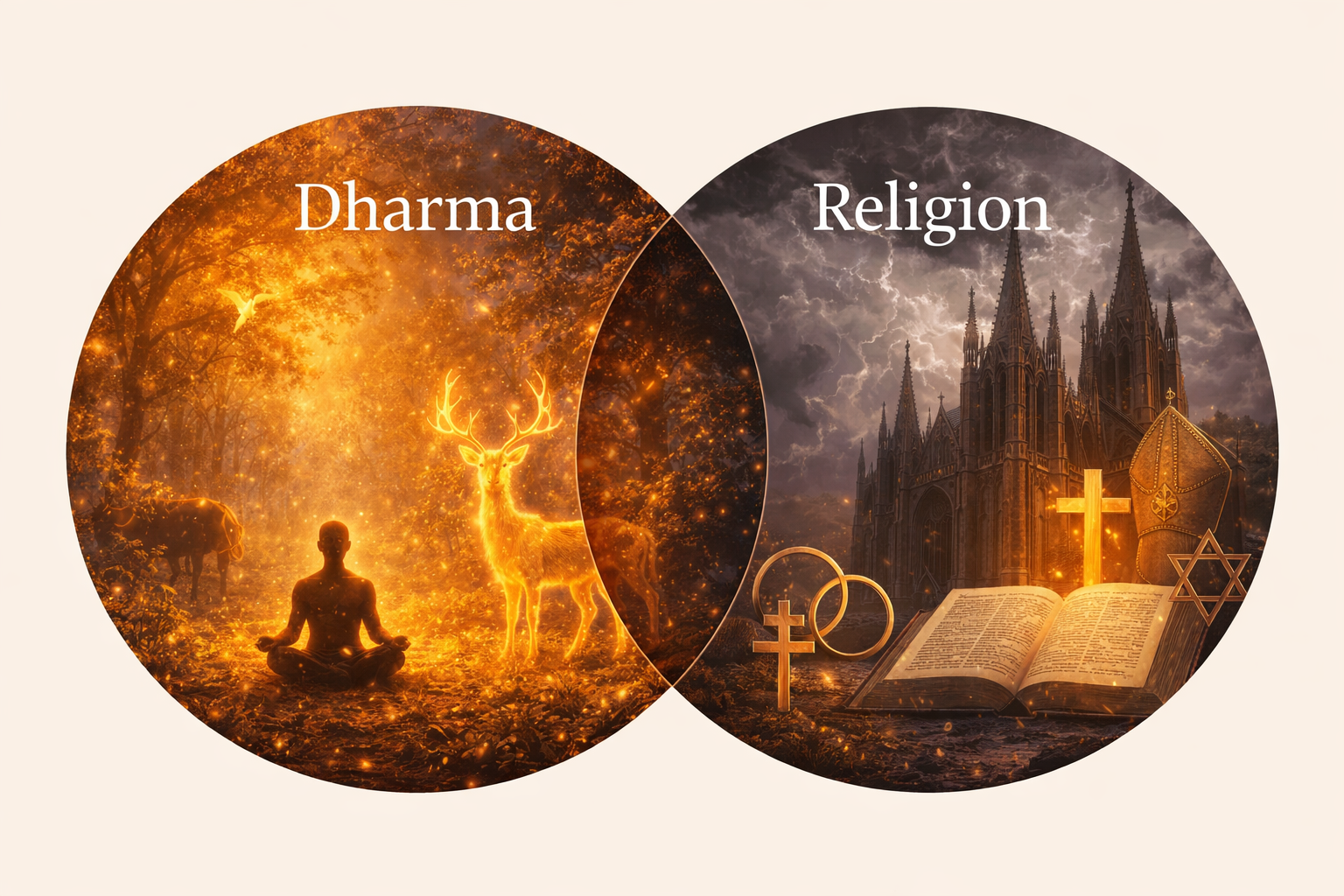
There is a word that has been mistranslated, misunderstood, and misrepresented more than perhaps any other in the long history of cross-cultural dialogue: Dharma.
When the West encountered India, it reached for the closest familiar concept it had — religion. And so dharma became “Hindu religion,” just as karma became “fate” and yoga became “exercise.” It seemed like a reasonable shortcut. It was not.
Dharma and religion are not just different words for the same thing. They are fundamentally different categories — as different as a river and a road, despite both being ways to get somewhere. To call dharma a religion is not merely a translation error; it is a category mistake — the kind that distorts understanding at the root level.
So what exactly sets them apart? Let’s explore.
The Core Difference: Experience vs. Belief
At the heart of this distinction lies a fundamental question: What is spirituality built upon?
Religion is built on belief and dogma — a set of truths handed down by a prophet, codified in a scripture, and maintained by an institution like the Church or the Ummah. You accept these truths on faith. You do not question them. Your salvation depends on your obedience to them.
Dharma, by contrast, is built on practice and personal experience. It does not ask you to believe in anything you have not tested for yourself. It asks you to meditate, to observe, to inquire, and to realize. The truth, in the dharmic framework, is not something given to you from outside — it is something you uncover from within.
This is not a subtle difference. It is the difference between being handed a map and being taught to navigate.
The Divine: Everywhere vs. Elsewhere
One of the sharpest contrasts between dharma and religion lies in how each understands the divine.
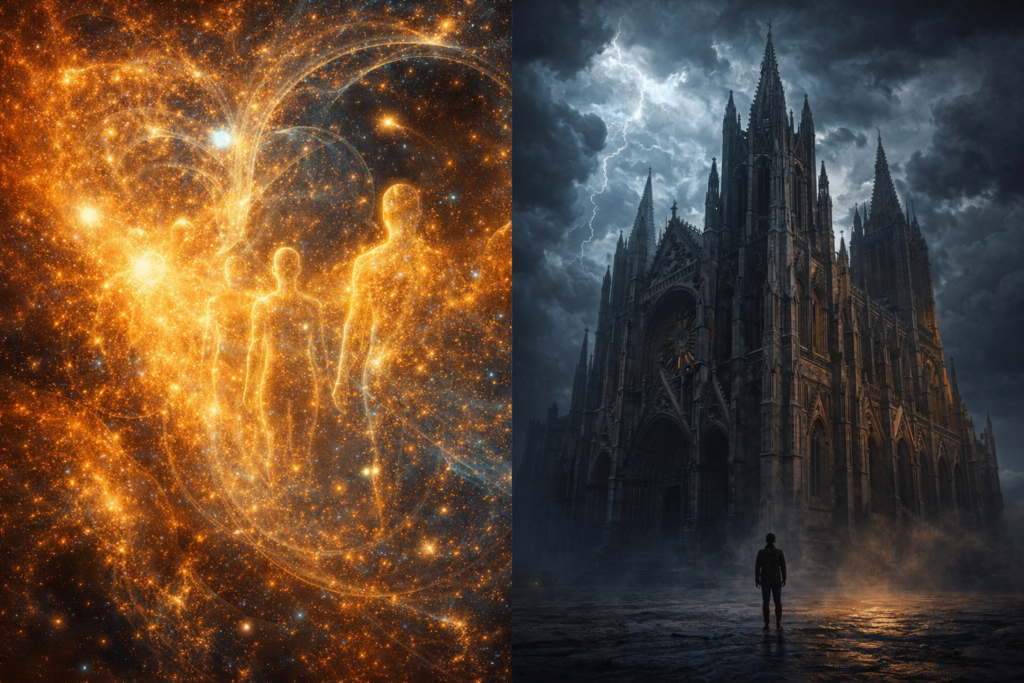
Dharma holds that God alone is the entire universe — every animate being, every rock, every river, every star is an expression of the same Supreme Consciousness, called Brahman. There is no separation between the creator and the creation. You are not merely a creation of God; you are, at the deepest level, a reflection of Brahman. Meditation is simply the practice of realizing this truth.
Religion, on the other hand, draws a strict line. There is one true God — transcendent, separate, jealous — and to suggest that a human being could become divine is considered the gravest of sins. Man is not a reflection of God; man is a sinner, fallen and helpless, entirely dependent on divine grace channelled through institutional intermediaries.
In dharma, divinity is the nature of all things. In religion, divinity is the exclusive property of a single being, forever beyond human reach.
The Messenger vs. The Message
Another profound distinction lies in how dharma and religion relate to their respective guides.
In dharma, a deity or a guru can show you the path — but moksha (liberation) must be realized by the individual alone. No one can do it for you. The guru points to the moon; it is you who must look up and see it. The message — the path toward liberation — matters infinitely more than the messenger.
In religion, the messenger is everything. The prophet is elevated to the highest pedestal. His authority is non-negotiable, his pronouncements eternal, and rejecting his mediation is not just spiritually inadvisable — it is a transgression. Your relationship with the divine is filtered entirely through the prophet, the Church, or the Ummah.
Dharma offers real spirituality — directly accessible to every individual, requiring no institutional permission. Religion offers what might be called surrogate spirituality — a packaged, mediated experience available only to those who accept the particular dogma of a given institution.
Man, Woman, and the Natural World
The contrast extends to how dharma and religion view human beings and the world around them.
Dharma sees no fundamental distinction between men and women — both are expressions of the same consciousness. This is reflected in the rich tradition of goddesses, feminine divine forms, and female spiritual figures in dharmic traditions. The divine is not gendered in any exclusive way.
Religion, however, has historically viewed woman as an afterthought — created from Adam’s rib, prone to temptation, in need of control. The divine, in the Abrahamic traditions, is explicitly male.
Similarly, dharma holds that man is simply one species among millions — superior only in his capacity to realize his true nature through meditation, but otherwise a co-inhabitant of a web of life, not its master. Religion, by contrast, grants “God’s chosen people” dominion over nature and every creature within it — a worldview that has had profound consequences for how the natural world has been treated.
Moksha vs. Heaven: What Are We Really Aiming For?
The final destinations envisioned by dharma and religion also reveal strikingly different conceptions of the good life and the good afterlife.
Dharma holds that the highest goal of human life is moksha — a state of unending bliss that is nothing other than merging with Brahman, the Supreme Consciousness. Moksha is not a location. It is not a reward. It is the realization of what you already are. And crucially, there are many paths to it — different practices, philosophies, and traditions can all lead there.
Religion holds that the highest goal is heaven — a place where material pleasures are available in unlimited quantity as a reward for earthly obedience. There is only one path to get there: redemption through the Church or acceptance of the prophet’s authority. All other roads lead to damnation.
One vision points inward, toward liberation. The other points outward, toward reward.
The Untranslatable Truth
The root problem is this: when colonial scholars encountered dharmic civilization, they had only one conceptual box available — religion. And so they placed dharma in it. But dharma does not fit in that box. It never did.
Dharma is a living framework for understanding reality, guiding ethical life, pursuing spiritual liberation, and maintaining harmony between the individual, society, and the cosmos. It has no founding prophet, no singular scripture decreed by God, no institutional authority that controls access to the divine, and no demand for exclusive belief.
These are not incidental differences. They are definitional ones.
As the scholar Rajiv Malhotra has written in his work on civilizational difference — from which much of this analysis is drawn — dharma and religion are untranslatables: two categories that simply do not map onto one another without fundamental distortion.
Conclusion: Dharma Sustains, Religion Destroys
There is a deceptively simple line that captures the spirit of this entire discussion: Dharma sustains, while religion destroys.
This is not a dismissal of the sincere spiritual yearning that exists within every religious tradition. People of faith across the world have led lives of great beauty and compassion. But as systems — as institutional, civilizational frameworks — dharma and religion operate by fundamentally different principles and produce fundamentally different outcomes.
Dharma, with its emphasis on personal realization, respect for all of existence, and openness to many paths, is a framework built for the long journey of civilizational flourishing. Religion, with its monopoly on truth, its division of the world into believers and infidels, and its institutional mediation of the divine, has historically proven far more capable of conquest than of liberation.
Understanding this distinction is not an academic exercise. In a world where civilizations are increasingly forced to confront one another, knowing what each truly stands for — not through borrowed translations, but on its own terms — may be one of the most important intellectual tasks of our time.
What Do You Think?
This is a conversation that deserves to be had openly and thoughtfully. Have you ever felt that the word “religion” doesn’t quite capture what dharma means to you? Or do you see more common ground between the two than this analysis suggests?
Share your thoughts in the comments below. If this piece made you see something differently, pass it along — these ideas need to travel.
References and further reading: Rajiv Malhotra, “Being Different: An Indian Challenge to Western Universalism”; Swami Vivekananda, “Complete Works”; S. Radhakrishnan, “The Hindu View of Life”